Most of what's floating through your home right now is invisible to you. Pollen rides in on a jacket, the dog leaves dander on the couch, and fine dust hangs in the air long after you think you've cleaned it up. I notice this stuff more than most people do, because I've spent years swapping filters in my own return and looking hard at what a good one pulls out. A pleated 10x20x2 air filter does more of that work than its price suggests. It can make the air in your home measurably cleaner.
TL;DR Quick Answers
10x20x2 air filter
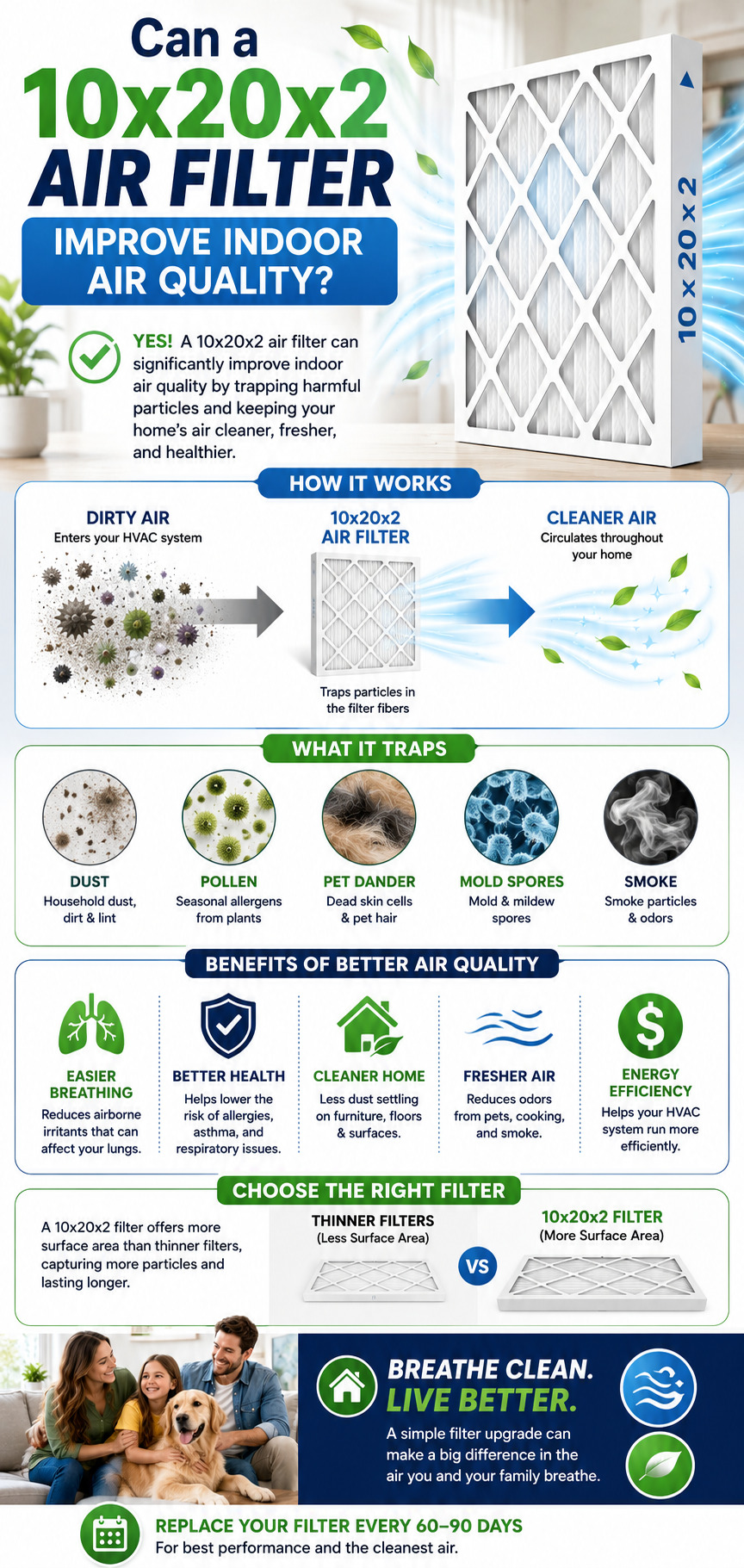
A 10x20x2 air filter is a two-inch-deep pleated filter sized to fit a 10x20 return or air handler slot. That extra depth gives it more surface area than a one-inch panel, so it traps more dust, pollen, and dander while still letting your system breathe. Higher MERV catches finer particles.
• Size: the 10x20x2 label is nominal, and the real filter is cut slightly smaller so it slides into the slot.
• Build: two-inch pleated media holds more debris and breathes easier than a flat one-inch filter.
• MERV choice: 8 for everyday dust, 11 for dander and pollen, 13 for the finest allergens.
• Replace: check it monthly, swap it every one to three months.
Top Takeaways
• A clean 10x20x2 filter cuts the dust and allergens cycling through your home, and you'll see the difference on your furniture.
• The two-inch depth holds more debris and breathes easier than a flat one-inch panel.
• Match the MERV to the job: 8 for everyday dust, 11 for dander and pollen, 13 for the finest particles.
• Check it monthly. Replace it before it clogs, not after.
• Pick a MERV your blower can actually move, or you'll starve the airflow you're trying to clean.
What a 10x20x2 Air Filter Actually Does
Here's the first thing that trips people up. The 10x20x2 stamped on the frame is the nominal size, the name you order by, not the exact measurement. The real filter runs a hair smaller so it slides into the slot without fighting you. Don't worry about that gap. What earns its keep is the two-inch depth. Those deeper pleats give the filter far more surface area than a flat one-inch panel, so it grabs more debris and still lets your system breathe while it works.
Choosing a MERV Level
MERV is the number that tells you how small a particle a filter can catch. Higher number, finer catch. I keep three grades on hand and I've run all of them through my own return over the years, so this isn't theory for me. A MERV 8 pulls the big stuff, the lint and carpet fibers and visible dust, around 90 percent of it in my own testing. Step up to a MERV 11 and you're closer to 95 percent, with pet dander and finer pollen starting to get caught. A MERV 13 gets me near 98 percent and reaches the small particles I care about most once pollen season hits. When allergies are the whole reason you're shopping, I reach for a pleated 10x20x2 air filter built for allergies.
How Often I Replace Mine
I check mine once a month, and I swap it on a schedule instead of waiting for it to look disgusting. A clogged filter strangles your airflow, which forces the whole system to work harder for dirtier air. My test takes two seconds. I hold the used filter up next to a sheet of white paper, and once it has gone gray, it's done.

“After years of evaluating HVAC filtration performance in real homes, we’ve consistently found that a 2-inch filter offers one of the best balances between particle capture and airflow. The extra media surface helps trap more contaminants without creating the pressure drop that can reduce system efficiency, making it a reliable choice for both indoor air quality and long-term HVAC health.”
7 Essential Resources I Keep Bookmarked for Cleaner Air
When I want to check my own thinking against people who study this for a living, here's where I go.
• How mechanical air filters capture particles, a plain-language primer on filter media and MERV.
• The inside story on indoor air quality, the foundational homeowner guide from the EPA.
• Keeping your AC filter working efficiently, maintenance guidance from the Department of Energy.
• How home air cleaning and filtration works, the American Lung Association on HVAC filters and MERV.
• The health science behind indoor air, a research overview from the National Institute of Environmental Health Sciences.
• What fine particles really are, a clear explainer on PM2.5 and why particle size matters.
• Particulate matter and your health, the California Air Resources Board on PM2.5 and PM10.
3 Statistics Worth Knowing
I don't put much weight on a number I can't trace back to its source. These three I can, and they shaped how I filter my own air.
• We spend about 90 percent of our time indoors, where some pollutants run two to five times higher than outside. (EPA indoor air data)
• The Department of Energy says to clean or replace an AC filter every month or two through the cooling season, since a clogged one drags down airflow and efficiency. (Department of Energy)
• The American Lung Association notes most systems ship with a low-efficiency filter near MERV 8, and recommends moving up to MERV 13 or higher to catch more and smaller particles. (American Lung Association)
What I Would Tell a Neighbor About This Size
If a neighbor asked me over the fence, I'd tell them the 10x20x2 is one of the easiest wins in their whole house. It costs almost nothing, it takes two minutes to change, and that two-inch pleated build does more than the price tag suggests. I'd also tell them not to chase the highest MERV on the shelf. A filter too dense for your blower chokes the airflow and leaves you worse off than where you started. For most homes I land on a MERV 11 or 13 in this size and change it on a schedule. That's the mix that has kept my own air noticeably cleaner, and it's what I'd put back in my return today.
Frequently Asked Questions
What is the best 10x20x2 air filter for allergies?
For allergies, I go with a pleated MERV 13 in this size. It catches the fine pollen and dander behind most flare-ups while still letting the system breathe the way it should.
Is a 10x20x2 pleated air filter better than a flat one?
In my experience, yes, and it isn't close. The pleats add surface area, so the filter traps more and keeps working longer before your airflow starts to drop.
How often should I change a 10x20x2 air filter?
I check mine every month and replace it every one to three months. Pets or a rough allergy season push me toward the shorter end of that range.
Where can I find a 10x20x2 air filter near me?
This is a stock size, sold across the country in stores and online, so you can have one on your doorstep just about anywhere without driving around to track it down.
Does a 10x20x2 air filter really improve indoor air quality?
It does, as long as you keep it clean and matched to your system. A fresh filter pulls a real share of the particles that would otherwise keep circling back through your rooms.
See Whether a 10x20x2 Filter Improves Your Air
Pull your current filter, confirm it reads 10x20x2, and slide in a pleated MERV 11 or 13 that matches your system. Within a week you'll have your own answer to whether a 10x20x2 air filter improves indoor air quality, with cleaner air protecting your family every time the blower runs.
Learn more about HVAC Care from one of our HVAC solutions branches…
Filterbuy HVAC Solutions - West Palm Beach FL
1655 Palm Beach Lakes Blvd., Ste 1005 West Palm Beach, FL 33401
(561) 448-3760
https://maps.app.goo.gl/VarpgNZnxuPQuW8A7